Most visitors to Oman meet the country's hospitality customs before they meet its landmarks — a cup of kahwa and a date, offered almost as a reflex by a shopkeeper, a hotel host, or a taxi driver's cousin. It can feel like a small, disconnected gesture in the moment. In practice, it's the same set of values that shapes how the Sultan Qaboos Grand Mosque welcomes visitors, dresses its expectations, and asks for a bit of quiet respect in return. Understanding one makes the other easier to read.
What the coffee ritual actually signals
Omani kahwa is a light, unfiltered coffee flavored with cardamom, poured from a long-spouted dallah pot into small handleless cups called finjan. It's served in small pours because the custom assumes refills rather than one large serving, and it's almost always paired with dates, whose sweetness offsets the coffee's spiced, slightly bitter edge. None of this is really about the drink itself — it's a greeting. Offering kahwa is one of the oldest and most consistent ways Omanis extend welcome to a guest, whether that guest is a family member, a business visitor, or a tourist who's wandered into a shop.
The etiquette around it is simple: accept with your right hand, hold your cup out again if you'd like more, and give it a small wobble when you hand it back to signal you're finished. Nobody expects a first-time visitor to know these gestures perfectly, and Omani hosts tend to be relaxed about it — but the underlying idea, that hospitality comes with a quiet, unspoken code of respect, is worth carrying into the rest of a Muscat trip.
How that same spirit shows up at the Grand Mosque
The Grand Mosque extends a similar kind of welcome, just in architectural and behavioral form rather than a cup and a plate. It's one of the few working mosques in the Gulf that opens its doors to non-Muslim visitors at all, and it does so on the same underlying logic as the coffee ritual: a guest is welcomed in, and in return is expected to observe a few simple courtesies rather than a long list of rules.
Why does the Grand Mosque welcome non-Muslim visitors?
The mosque sets aside specific visiting hours for non-Muslim tourists, generally in the mornings on days other than Friday, treating sightseeing as a form of cultural exchange rather than an intrusion on worship. That openness is itself a hospitality gesture — the same impulse that has a shopkeeper handing you a finjan is what keeps the courtyard open to visitors who aren't there to pray, as long as the visit is conducted with a reasonable amount of care.
The courtesies in return are straightforward: modest dress for everyone (shoulders and knees covered, with a headscarf for women in the main prayer hall areas), lowered voices, and general awareness that it remains an active place of worship even during visiting hours. None of it is meant to be a hurdle. Most travelers find it closer to the same low-key, unspoken code that governs accepting or declining a second cup of coffee — small signals of respect that go a long way.
Where to actually experience the coffee ritual in Muscat
Muttrah Souq, along the old harbour corniche, is one of the more natural places to encounter it as a visitor rather than seeking it out separately — a number of stallholders in the souq's older sections still offer coffee to browsing customers as a simple part of doing business, no purchase expected. A handful of dedicated Omani coffee houses have opened around Muscat more recently too, for a slower, seated version of the same tradition with more explanation of what's being served. Either way works as a first real introduction to the custom before or after a Grand Mosque visit, since the two sit at opposite ends of the city and pair well into a single day.
Building both into one day in Muscat
Because the mosque's best visiting window is a short one in the morning — the courtyard gets busy and the light flattens out within an hour or so of opening — most visitors are done there by mid-morning, leaving the rest of the day open. A coffee stop in Muttrah or Old Muscat later on rounds out the day without feeling rushed, and gives a much fuller sense of Omani hospitality than the mosque alone: one experience built around architecture and quiet, the other built around a shared cup and unhurried conversation.
Where photography fits into a visit like this
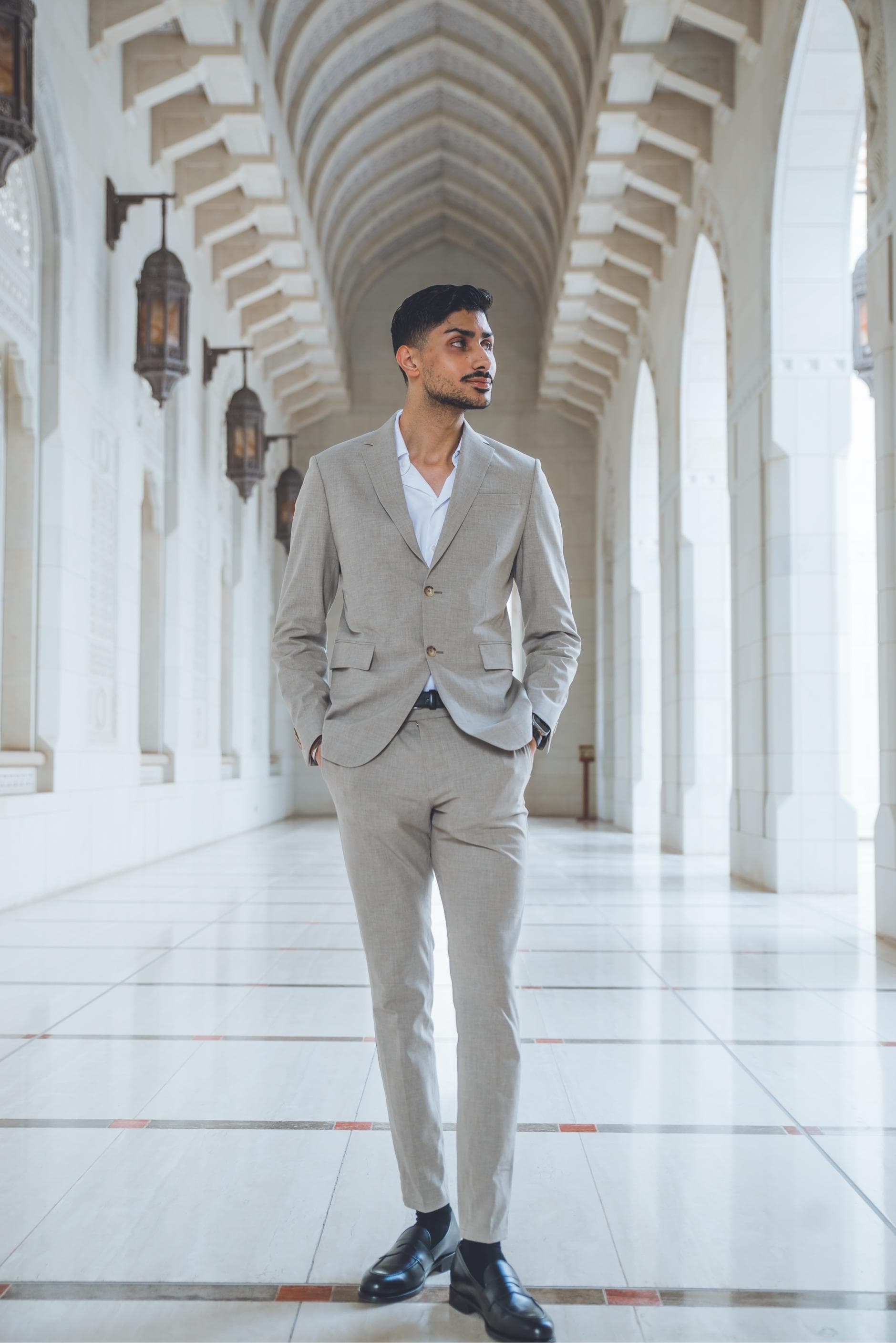
The Grand Mosque's courtyard — marble underfoot, carved stone columns, the dome catching the early light — is consistently the most requested backdrop for portraits I shoot in Muscat, and the same modest, flowing fabric that the mosque's dress code calls for tends to photograph beautifully against the white marble. If you're building a session around a visit here, I've written a more detailed guide to golden hour timing at the Grand Mosque that covers exactly when the light works best and how much time to budget.
A portrait session at the mosque tends to capture something closer to what a trip to Oman is actually about than a generic tourist photo would — the same quiet sense of welcome and respect that runs through the coffee ritual, just rendered in marble and morning light instead of a finjan.
If you'd like to build a session around your visit, message me on WhatsApp at +968 9584 2090 with your travel dates, and I can suggest timing that works well with both the mosque's light and the rest of your day. See packages and pricing to get started.
Ready to book your Muscat session?
Message on WhatsApp for availability during the September–January season.
Message on WhatsAppOr call/text +968 9584 2090 directly